
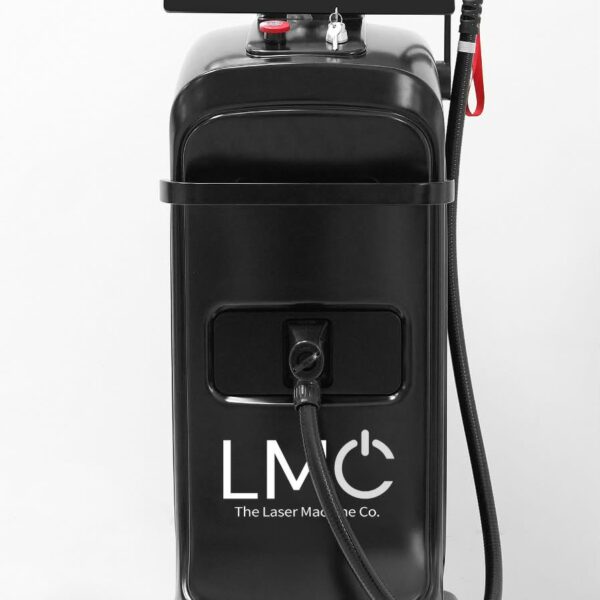
EMS Body Sculpting Machines: The UK Buyer's Guide
What the technology actually does, what it costs, and how to avoid buying the wrong thing
Body sculpting is the fastest-moving category in UK aesthetics right now, and it is also the one with the widest gap between what machines cost and what they are worth. You can buy something described as an "EMS body sculpting machine" on eBay for under £200. You can buy a branded clinical system for the price of a family car. Both are sold using near-identical language about supramaximal contractions and thousands of sit-ups per session.
That range is not a reflection of a broad market. It is a reflection of the fact that almost nobody buying these machines knows what to compare. Laser buyers have wavelengths, wattage and pulse duration to anchor on. Body sculpting buyers get handed marketing terms — HI-EMT, HIFEM, EMS, EMT, EMSlim — that are used interchangeably by suppliers who often do not know the difference themselves.
This guide is written for UK clinic and salon owners deciding whether to add body contouring, and what to buy if they do. It covers the technology honestly, sets out what the market actually charges at each tier, explains which specifications matter and which are noise, and walks through the practical realities — contraindication screening, room requirements, insurance, and how to build a business case that survives contact with reality rather than one built on a supplier's revenue projection.
We supply the LMC Myo Sculpt Elite, and it appears in this guide. It is one option among several, and it is not the right machine for every clinic. Where it is not, we have said so.
WHAT THIS GUIDE COVERS
- What EMS body sculpting actually is — and what the marketing gets wrong
- What UK clinics really pay: the four price tiers
- The specifications that matter (and the ones that don't)
- Pelvic floor: the revenue stream most buyers overlook
- The LMC Myo Sculpt Elite
- Hidden costs and practical realities
- Regulation, insurance and training in the UK
- Finance options
- Red flags when buying
- Building a business case that holds up
- Frequently asked questions
What EMS Body Sculpting Actually Is
Three different technologies sold under one name
The single most useful thing you can do before buying is understand that "EMS body sculpting" describes at least three distinct technologies, which behave differently, cost differently, and produce different results. Suppliers routinely blur them. Some do it deliberately. Many do it because they genuinely do not know.
EMS — Electrical Muscle Stimulation
Traditional EMS delivers an electrical current through pads or electrodes placed on the skin. The current stimulates the motor nerves, which causes the muscle to contract. This is decades-old technology — it is what sits inside the £40 devices on eBay and the £150 pad systems marketed for home use.
It works, in a limited way, but the problem is depth. Because the current passes through skin and subcutaneous fat, the surface sensation becomes uncomfortable long before the current reaching the deeper muscle is meaningful — so clients with more subcutaneous fat, often exactly the clients seeking body contouring, get the least benefit. Pure EMS is not a clinical body sculpting proposition on its own.
HI-EMT / HIFEM — High-Intensity Electromagnetic Muscle Stimulation
This is the technology that created the category. Rather than passing current through the skin, a coil inside the applicator generates a rapidly changing electromagnetic field. That field induces a current directly in the motor neurons of the underlying muscle, bypassing the skin entirely.
The practical consequences matter. There is no uncomfortable surface sensation, because the skin is not being stimulated. The field reaches muscle several centimetres deep regardless of the fat layer above it. And the contractions produced are supramaximal — more complete than a person can achieve voluntarily, because voluntary contraction never recruits every available fibre at once.
You will see HI-EMT, HIFEM, EMT and various brand-specific acronyms used for this. They describe the same underlying principle. If a machine is being sold as a professional body sculpting system and it does not use electromagnetic stimulation, it is not competing in this category, whatever the listing says.
RF — Radiofrequency
RF is a heating technology. It raises the temperature of the tissue in the treatment area, which supports fat metabolism and stimulates collagen. On its own it is a skin tightening and mild fat reduction treatment, and it has been in clinics for years.
The reason RF appears on body sculpting machines is that the two technologies address different problems. Electromagnetic stimulation builds and thickens muscle. RF addresses the fat layer and skin laxity sitting above it. A client who builds abdominal muscle underneath a soft, loose fat layer will notice less visible change than a client where both are being worked on. Combining them is not a gimmick — it is the difference between a result the client can see in the mirror and one they can only feel.
THE PRACTICAL TEST
When a supplier tells you a machine does "EMS body sculpting", ask one question: is the muscle stimulation electromagnetic or electrical?
If they cannot answer immediately and clearly, they do not understand what they are selling you. That tells you everything you need to know about the support you will get after the invoice is paid.
What the treatment actually does
A session is short — under half an hour on every system in this category. Applicators are strapped over the target area — abdomen, buttocks, arms, thighs or calves — and cycle through frequencies that alternate between contraction phases and recovery phases. The client stays fully clothed, does not need to undress, and can read or use their phone throughout.
Course structure is usually four to eight sessions, delivered two to four times per week rather than spread out. That cadence matters commercially and is often missed by buyers coming from laser: unlike tattoo or hair removal, where sessions are spaced weeks apart to allow healing, body sculpting is a short, intensive course. A client completes and pays for the whole thing inside three to four weeks. Your diary fills and empties much faster than a laser diary does.
On expectations, be careful. This is a muscle conditioning and body contouring treatment, not a weight loss treatment. It produces measurable change in muscle thickness and abdominal definition, and supports fat metabolism in the treated area. It does not replace diet, and a client expecting the scales to move will be disappointed. Clinics that set that expectation correctly at consultation get better outcomes, better reviews and fewer refund conversations.
What UK Clinics Actually Pay
Four tiers, and what separates them
Prices in this category span more than two orders of magnitude. Here is what sits at each level, and what you are actually paying for.
TIER 1 · NOT CLINIC EQUIPMENT
Under £1,500
Marketplace imports, pad systems, home-use devices
Everything in this bracket is pad-based electrical stimulation or a low-output unit shipped direct from a marketplace listing. There is no UK entity behind it, no warranty you can enforce, no training, no parts supply and no technical support. Many carry no meaningful conformity documentation.
Buy this if: you want a personal-use device. Not for commercial treatment. Your insurer will almost certainly decline cover, and if a client is injured you have no defensible position.
TIER 2 · ENTRY COMMERCIAL
£3,000 – £7,000
Direct import, or a UK reseller with a thin margin
Genuine electromagnetic systems start appearing here. Typically two handles, a smaller screen, fewer preset programmes, and RF either absent or added as a low-power afterthought. Some are sold by UK resellers as a "business in a box" with basic training bundled in; others are direct-from-factory purchases where you are the importer.
The risk at this tier is not usually the machine on day one. It is month fourteen, when a handle fails. If you imported directly, you are shipping a component to another continent at your own cost and waiting. If you bought from a reseller with no engineering capability, they are doing the same thing on your behalf and your diary is empty either way.
Buy this if: you are testing demand, you have a second machine or an alternative revenue stream to fall back on, and you have read the warranty terms properly — specifically who pays for shipping on a warranty repair.
TIER 3 · PROFESSIONAL CLINIC SYSTEMS
£9,000 – £20,000
Four-handle systems, integrated RF, UK supplier, training and warranty included
This is the working tier for a UK clinic that intends to run body sculpting as a real service line. Four applicator ports rather than two, meaning you can treat two areas simultaneously or run a full-body protocol without repositioning constantly. Integrated RF at usable power rather than a token setting. A large touchscreen with both automatic and manual modes. Preset programmes that a newly trained therapist can follow safely.
Critically, you are buying a UK supplier relationship: a 12-month warranty you can actually enforce, in-person training, parts held in the country, and someone who answers the phone. The LMC Myo Sculpt Elite sits in this tier at £12,999.
Buy this if: body sculpting is going to be a named service on your price list rather than an experiment.
TIER 4 · BRANDED CLINICAL PLATFORMS
£40,000 – £100,000+
The trademarked names, plus ongoing licence and consumable costs
The category-defining branded platforms sit here, and the figure on the invoice is frequently not the full cost — many operate per-treatment licensing, mandatory service contracts, or applicator replacement schedules that continue for the life of the machine.
What you get is a genuine clinical evidence base, brand recognition that supports premium pricing, and inclusion in a manufacturer's national marketing. In a competitive city market where clients arrive already searching the brand name, that can be worth it.
Buy this if: your clients are searching for the brand, not the treatment, and your pricing can carry the capital cost. For most independent UK clinics and salons, it cannot.
Not sure which tier fits your clinic?
A 20-minute call is usually enough to work out whether body sculpting suits your client base at all — before anyone talks about machines.
Video/Zoom calls available UK-wide · In-person visits welcome at our Rossendale clinic
The Specifications That Matter
And the ones suppliers use to distract you
Body sculpting spec sheets are noisier than laser spec sheets, largely because there is no equivalent of wavelength to anchor a comparison. Here is what to actually interrogate.
1. Number of applicator ports — and how many run at once
This is the single biggest determinant of what you can charge and how many clients you can process. A two-handle machine treats one area at a time. A four-port machine can run large body applicators on the abdomen while small applicators work the arms, or cover both glutes simultaneously.
Watch for the distinction between ports and simultaneous output. Some machines have four sockets but only power two at a time. Ask specifically: how many applicators deliver output concurrently? A machine that treats two areas at once effectively halves your chair time per course, which changes your economics more than any other single specification.
2. Large and small applicators as standard
Abdomen and buttocks need large applicators. Arms and calves need small ones. Machines supplied with only large handles cannot treat limbs properly, which removes a meaningful slice of your addressable treatments — arm and calf work is frequently what brings in the client who is not interested in an abdominal course.
Check whether small handles are included or sold separately, and whether the brackets are interchangeable. On the Myo Sculpt Elite the large and small handles use different brackets, both supplied — a small detail, but exactly the kind of thing that turns into a three-week delay when it is missing.
3. Frequency range and programme structure
Frequency determines the character of the contraction. Lower frequencies produce distinct, separated contractions suited to deconditioned clients. Higher frequencies produce sustained tetanic contraction used for strength and endurance work. A machine with a narrow frequency band cannot properly serve both the sedentary client and the gym-going client.
Look for a genuine spread, and for that spread to be organised into usable presets rather than left as a raw range on a slider. What you want is a machine that can serve a client who has not exercised in a decade and a client who trains four times a week, without your therapist having to invent settings for either. Ask any supplier to walk you through their preset structure on a live screen rather than reading you a frequency range off a spec sheet.
Automatic and manual modes are not the same feature
Automatic mode fixes the frequency and asks the operator only to set intensity and time. It is what a newly trained therapist should use, and it is what keeps treatments consistent across staff.
Manual mode exposes frequency, energy and time independently, allowing targeted protocols on specific muscle groups. It is what an experienced operator uses to differentiate your clinic from the salon down the road running default settings.
4. RF power and independent control
If a machine advertises RF, establish whether RF intensity can be set independently of the muscle stimulation intensity, per handle. On a properly specified system it can. That matters because the correct ratio differs by area: buttock protocols typically run both higher, arms run both lower, and abdomen sits in between with RF proportionally lower than the electromagnetic setting.
If RF is locked to a single global value, or tied to the stimulation level, you are getting a marketing feature rather than a clinical one.
5. Screen size and interface language
Trivial-sounding and consistently underrated. A large screen with a properly translated interface is the difference between a therapist adjusting confidently mid-treatment and a therapist guessing. Many imported machines arrive with partially machine-translated interfaces where critical settings are ambiguous. Ask for photographs of the live screens, not the brochure render.
What matters less than suppliers claim
Tesla ratings quoted without measurement conditions. Almost every machine in this category advertises a peak magnetic flux density figure, and almost none state where it was measured. At the coil face, at one centimetre, or at treatment depth? Those produce very different numbers from the same machine.
This applies to our specification as much as anyone else's, so we will be straight about it: a Tesla figure quoted without its measurement conditions cannot be meaningfully compared between suppliers. It is not worthless — a machine advertising a low single-digit figure and one advertising a mid-teens figure are not in the same class — but treating a two-point difference between two suppliers as decisive is false precision. Ask any supplier, us included, how and where their figure was measured, and weight the answer by how confidently they can tell you.
"Equivalent to 20,000 sit-ups". This is a marketing translation of contraction counts, not a physiological claim, and every supplier in the category uses it. It tells you nothing about one machine versus another.
Total wattage, in isolation. On a laser, output power maps fairly directly to clinical effect. On an electromagnetic system, the headline figure describes what the unit draws and can deliver across all channels combined, not what reaches any one muscle group. It is a reasonable indicator of whether a machine can drive four applicators properly rather than two, which does matter. It is not a proxy for results, and a machine advertising a bigger number is not automatically better at treating an abdomen.
Pelvic Floor: The Revenue Stream Most Buyers Overlook
A different client, a different price point, and far less competition
Most clinic owners evaluate a body sculpting machine entirely on abdominal and glute treatments, because that is what the marketing shows. In doing so they routinely miss the attachment that changes the business case: the pelvic seat cushion.
The same electromagnetic principle applied through a seat cushion stimulates the pelvic floor musculature. The client sits fully clothed on the cushion for the duration of the session. There is no undressing, no examination, no practitioner contact with the treatment area at all. On the Myo Sculpt Elite the cushion is an optional addition rather than part of the standard configuration, and it operates independently of the handle system — meaning it runs as its own treatment without occupying any of the four applicator ports.
Commercially this is a genuinely different proposition to abdominal sculpting, for three reasons.
The client is different. Postnatal women and women in and around menopause are a large, underserved and highly motivated group. They are not shopping on price in the way that a client comparing abdominal sculpting packages is, and they are not being aggressively marketed to by every salon in your town.
Referral behaviour is different. This is a treatment clients tell their friends about privately and specifically. Word of mouth in this category is unusually strong, and it does not depend on before-and-after photography — which you cannot produce for this treatment anyway.
Competition is thinner. Most clinics that buy a body sculpting machine never promote the pelvic function at all, either because the cushion was an afterthought at purchase or because nobody was trained on it. If you actively market it, you are frequently the only local provider.
BEFORE YOU BUILD A PRICE LIST AROUND IT
Pelvic floor work brings clients presenting with a clinical symptom rather than a cosmetic goal. That changes your obligations.
Be explicit in your consultation and marketing that this is a muscle conditioning treatment, not a medical treatment for incontinence or prolapse, and refer clients with symptoms to their GP. Confirm in writing with your insurer that pelvic floor treatment is included in your cover before you offer it — some policies treat it differently to body contouring. Getting this wrong is a bigger problem than getting a treatment protocol wrong.
Ask any supplier whether the pelvic cushion is included in the quoted price or sold as an accessory, whether it runs independently or occupies an applicator port, and whether their training covers it. Answers vary widely, and the difference is worth thousands over the life of the machine.
The LMC Myo Sculpt Elite
Our 3-in-1 body sculpting system — specifications and honest positioning
We supply one body sculpting machine rather than a range, because we would rather support one system properly than list six we cannot service. Here is exactly what it is.
PROFESSIONAL · 3-IN-1 BODY SCULPTING
LMC Myo Sculpt Elite
£12,999
Includes training & 12-month warranty
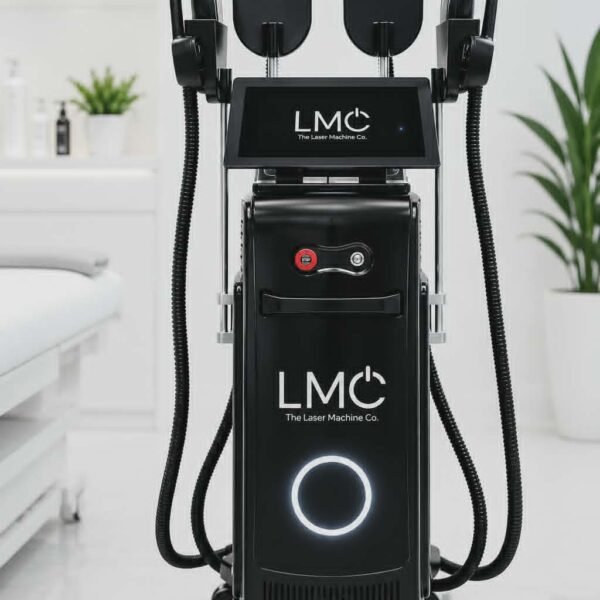
A four-port system combining HI-EMT/HIFEM electromagnetic muscle stimulation, EMS and wide-surface radiofrequency, supplied with two large body applicators, two small limb applicators, brackets, hangers and mounting hardware. Automatic and manual operating modes on a 15.6-inch rotatable touchscreen. The pelvic stimulation cushion is available as an optional addition and runs independently of the handles. CE certified, 12-month warranty, training included either online or in person at our Rossendale clinic.
Ideal for: established clinics and salons adding body contouring as a named service line, particularly those with an existing female client base where pelvic floor work can be marketed alongside abdominal and glute treatments.
View the Myo Sculpt Elite →Operating modes in detail
Automatic mode mirrors a structured gym session. Frequency is fixed by the programme; the operator sets energy intensity and treatment duration, and assigns RF and HIFEM levels per handle. This is the mode we train new operators on, and the one we recommend for consistency where more than one therapist runs treatments.
Manual mode gives full control over frequency, energy and treatment time. Rather than holding one frequency for the whole session, it cycles three in a repeating ten-second sequence, so the muscle is worked across a spread rather than adapting to a single rhythm.
Sitting on top of that are five preset training levels, running from a basic setting intended for clients who barely exercise and for weak muscle groups, up through adaptation and intermediate levels, to an intensive strength setting aimed at regular gym-goers and athletes. That ladder is the practical value of manual mode: your therapist selects a level based on the client's actual fitness and the area being treated, rather than guessing at raw numbers.
The rule that governs every setting
Energy and frequency work against each other for client comfort. If you raise the electromagnetic energy, the frequency generally needs to come down to keep the treatment tolerable. Every treatment starts low and builds to the client's comfortable maximum, and the operator keeps talking to the client throughout rather than setting a level and leaving the room. Any training worth having drills this before it teaches anything else.
Starting parameters differ by area, and the ranking is consistent: buttocks tolerate the highest settings, the abdomen sits lower and needs more care, and arms and calves lower still. RF is set proportionally beneath the electromagnetic level in every case. Your training covers the specific starting points for each area — what matters when you are comparing machines is that the system lets you set them independently per handle in the first place.
Where this machine is not the right answer
If you want the brand recognition of a trademarked platform because your local market is already searching for it by name, buy that instead. We cannot give you that, and no independently branded machine can.
If you are testing whether your clients want body sculpting at all and cannot commit to a service line, £12,999 is the wrong first step — run a survey of your existing client base first, or start at Tier 2 with your eyes open about the support risk.
And if your client base is predominantly men seeking fat reduction rather than muscle definition, be honest with yourself about the fit. This technology builds and defines muscle and supports fat metabolism in the treated area. It is not a fat removal machine, and selling it as one produces disappointed clients.
Hidden Costs and Practical Realities
What the quote does not tell you
Body sculpting has an unusually good cost profile compared with most clinic equipment. That is genuinely its strongest commercial argument, and it is worth understanding precisely where the savings are and where the costs still sit.
Consumables: effectively zero
This is the headline advantage and it is real. There are no cartridges, no crystals, no cryo membranes, no gel pads, no tips with a shot count. A laser tattoo removal machine has a lamp or handpiece with a finite lifespan and a replacement cost you should be budgeting for from day one. HIFU has transducer cartridges billed per shot. Cryolipolysis has membranes at several pounds per treatment.
An electromagnetic body sculpting machine has straps, which wear out slowly and cost very little. Your marginal cost per treatment is close to your electricity and your therapist's time. Over three years that difference against a consumable-heavy platform runs well into four figures and sometimes five.
Room and power
The machine needs a dedicated three-pin high-power socket on a properly earthed supply. It should not share a circuit with other high-draw equipment running at the same time — low-draw appliances are fine, but do not run it on the same ring as a second heavy machine. If your treatment room's electrics are older, get an electrician to confirm before delivery rather than after.
Space requirements are modest, but the treatment bed needs clear access on both sides so applicators and straps can be positioned. A room you can only reach from one side makes four-handle treatments awkward and slow.
There is one operational detail buyers consistently miss when planning their diary: the machine needs standby time. After each course of treatment it should rest before the next, and there is a short wait between reusing the same handle. Building a diary on back-to-back thirty-minute slots with no gap will not work in practice. Plan for genuine turnaround between clients — which you need for the room anyway.
Contraindication screening — the real operational cost
This is where body sculpting differs most sharply from the treatments many buyers are used to, and where the honest cost sits. The contraindication list is long and it is absolute in places, not advisory.
Anyone with a cardiac pacemaker, defibrillator, neurostimulator or implanted drug pump cannot be treated. Nor can anyone with metal implants or artificial bone in or near the treatment area — and that includes metal dental work where relevant to the field. Pregnancy, breastfeeding and menstruation all exclude treatment, and clients close to their period should be treated cautiously as treatment may bring it forward or cause cramping. Epilepsy, serious cardiovascular disease, severe hypertension, arrhythmia, diabetes, deep vein thrombosis, acute inflammation, malignancy, immune dysfunction, renal failure, severe infection, open or bleeding wounds, and areas containing dermal fillers or recent cosmetic surgery are all exclusions.
There are practical rules on top of the medical ones. All metal must come off the client before treatment, including jewellery and anything metallic on clothing. Phones, earphones and electronic watches come out of the room. The abdomen is not treated within an hour of eating. Treatment avoids passing directly over the ribs. Nobody else touches the client, the operator or the applicators while the machine is running.
Budget for the consultation, not just the treatment
A proper body sculpting consultation takes longer than a laser patch test conversation, because the screening is broader and much of it depends on the client volunteering medical information they may not think is relevant. Build a written medical questionnaire before you take your first booking, have the client sign it, and keep it. Suppliers rarely mention this because it is unglamorous. It is also the thing that protects you.
Delivery, inspection and the first three days
Whoever you buy from, check the machine the day it arrives. Our terms require any fault or transit damage to be reported within three days of receipt, after which standard warranty terms take over — and most reputable suppliers operate a similar window. Unbox it, connect every handle, run each one, and check the accessory list against the delivery note before you sign anything off and put the box in the loft. Keep the original packaging: if a machine ever does need to go back, transit damage in inadequate packaging is not covered by anyone.
Marketing spend
The genuine hidden cost in this category is client acquisition. Laser tattoo removal has existing search demand — people actively look for it. Body sculpting demand in most UK towns has to be created, because the client does not wake up searching for electromagnetic muscle stimulation. They are looking at a photograph on Instagram.
Realistically, budget for paid social from launch, and budget for before-and-after content production — consistent lighting, consistent positioning, consistent timing. Clinics that treat their first ten clients at a reduced rate purely to build a photo library convert far better in month three than clinics that launch at full price with stock imagery. Factor that into your first-quarter numbers rather than treating it as a surprise.
Regulation, Insurance and Training in the UK
Different rules to laser — which cuts both ways
If you already run laser treatments, your instinct will be to assume body sculpting sits under the same framework. It does not, and the difference is worth understanding properly before you assume either that you are covered or that you need something you do not.
Laser and IPL treatments attract specific attention from local authorities in much of the UK, with licensing regimes and expectations around laser safety qualifications and a designated protection role. Electromagnetic muscle stimulation is not a laser and does not fall under those laser-specific requirements. In practical terms, the barrier to entry is lower.
That is precisely why it deserves more care rather than less. A lower regulatory floor does not lower your duty of care, and it does not lower your exposure if something goes wrong. Three things to establish before you treat a paying client:
1. Confirm your insurance in writing, naming the technology
Do not assume an existing aesthetics policy covers body contouring. Contact your insurer, name the machine and the technologies it uses — electromagnetic muscle stimulation and radiofrequency — and ask them to confirm cover in writing. If you intend to offer pelvic floor treatment, name that separately; it is not always treated the same way as body contouring. A verbal assurance on the phone is worth nothing at claim stage.
2. Check your local authority position
Requirements for special treatment premises registration vary meaningfully between councils, and some local schemes cover a broader set of treatments than the laser-specific rules. A five-minute call to your environmental health team costs nothing and occasionally saves a great deal.
3. Get trained properly, and get it documented
Training on this technology is less about technical operation — the interface is straightforward — and much more about client selection, screening and expectation setting. That is where the risk actually lives. Whatever training you receive, keep a record of it: your insurer may ask, and it is the first thing anyone looks for if a complaint is ever made.
Training is included with the Myo Sculpt Elite, delivered either online or in person at our Rossendale clinic. If you have the option, take the in-person route. What matters more than any certificate is that your therapist has run real treatments on real clients under supervision before doing it alone in your treatment room, and knows exactly which clients to turn away — and that is difficult to achieve over a video call.
One thing to be sceptical of when comparing suppliers: several in this market advertise a "certificate of proficiency" issued by themselves. That is a record that you attended their training. It is not an accredited qualification, and it carries no weight with an insurer or a local authority beyond evidencing that training took place. Ask any supplier making certification claims exactly who accredits it and what it entitles you to do. The honest ones will tell you it is their own document.
Finance Options
Spreading the cost without distorting the business case
Most UK clinics finance rather than buy outright, and for a machine with negligible consumable costs that generally makes sense — the treatment revenue starts immediately while the capital cost spreads.
We work with Ideal4Finance for equipment finance across our range, available on every machine over £1,000. Terms run from 24 months up to 120 months at a fixed 15.9% APR — the same rate for every application, with no risk-based pricing. Three deposit routes are available: no deposit at all with the full price financed, a £999 deposit, or a £2,999 deposit with the balance financed. Applications are assessed on the business, most decisions come back within minutes, and you will need UK business or sole trader registration plus basic financial information.
You can model the monthly cost against any machine, term and deposit combination using the finance calculator before speaking to anyone. If you would rather pay outright, we also accept card payment without any application process.
Do the arithmetic on the total, not the monthly
A long term makes any machine look affordable per month, and suppliers know it. The honest way to assess a finance agreement is to multiply the monthly payment by the number of months, add the deposit, and compare that total to the cash price. That is what the machine actually costs you.
Then ask a second question: will this machine still be the one you want in year eight? A 120-month term on a technology that moves quickly can leave you paying for a machine you have already replaced. Shorter terms cost more per month and less overall, and they leave you free sooner.
One further point specific to this category. Because there are no consumables, your monthly finance payment is very close to your total fixed cost of ownership. That makes the break-even calculation unusually clean: work out how many treatments per month cover the payment, and everything above that line is close to contribution. Very few machine categories let you model it that simply — a HIFU or RF microneedling platform carries a cartridge or tip cost on every single treatment, and a HydroFacial system carries solutions and tips, so the same arithmetic needs a per-treatment consumable line that body sculpting simply does not have.
Red Flags When Buying
Patterns worth walking away from
No UK address, or an address that is a mailbox
Check Companies House. Check how long the company has traded. A supplier with no UK premises cannot hold parts, cannot train you in person, and cannot be pursued easily if the machine fails. The website will look identical to a real supplier's website.
Revenue projections presented as a selling point
You will see figures like "earn over £36,000 a year" attached to these machines. Read the assumption underneath: it is usually a fixed number of clients per week at a fixed price, every week, from launch. No ramp-up, no cancellations, no seasonality, no marketing cost. A supplier who leads with a revenue figure rather than a specification is selling you a spreadsheet, not a machine.
Vagueness about who pays for warranty shipping
"12-month warranty" is close to meaningless on its own. Ask what happens mechanically when a handle fails in month seven: who diagnoses it, who ships it, who pays for the shipping, and how long you are without the machine. Get the answer in writing. Most faults in this category can be resolved remotely, but you want to know the process before you need it, not after.
Handles and applicators excluded from the warranty
This is the specific trick to watch for. Some warranties cover the main unit but classify applicators as consumable parts, which are exactly the components that fail. Confirm explicitly that handles are covered, and for how long.
Reluctance to demonstrate the machine on a real person
You should be able to feel the treatment before you buy, in person or at minimum see it running live on a video call with someone in the applicators. A supplier who will only show you brochure imagery and a specification PDF may not have the machine in the country.
Pressure and expiring discounts
A price that disappears at the end of the call is a sales technique, not a commercial reality. Equipment at this level is a considered purchase. Any supplier confident in their machine will still be there next week at the same price.
No mention of contraindications anywhere in the sales process
If a supplier gets through an entire pitch without once mentioning pacemakers, metal implants or pregnancy, they are either not trained on their own product or they are prioritising the sale over your clients' safety. Both should end the conversation.
Want to feel the treatment before you commit?
Come to the clinic in Rossendale and try it, or see it running live on a video call. No obligation either way.
Video/Zoom calls available UK-wide · In-person visits welcome at our Rossendale clinic
Building a Business Case That Holds Up
How to model it yourself, rather than trusting a supplier's spreadsheet
We are not going to give you a projected annual revenue figure, because we do not know your market, your prices or your diary, and any number we invented would be worth exactly as much as the ones you have seen elsewhere. What we can do is show you how to build the calculation honestly.
Step one: find your real local price
Do not use a national average or a supplier's suggested price. Search for body sculpting, EMS or muscle toning treatments within a twenty-mile radius and record what clinics actually charge per session and per course. UK pricing in this category varies enormously by region — a session price that works in a city centre will not transfer to a market town, and the reverse is also true.
Note two things while you are looking: how many local providers there are, and whether any of them mention pelvic floor treatment. The second question often matters more than the first.
Step two: model the course, not the session
Clients buy a course of four to eight sessions, not individual treatments, and the course price is what actually lands in your account. Because sessions run two to four times per week, a client completes and pays inside three to four weeks. Model in course revenue and course duration.
This is where body sculpting differs most from laser economics. A tattoo removal client might be with you for eighteen months. A body sculpting client is with you for a month, then either books a maintenance schedule or leaves. That means faster cash but a diary you have to keep refilling, and it makes your marketing engine more important than your machine.
Step three: work out your break-even in treatments per month
Add up your genuine monthly fixed costs for this service: the finance payment, the marginal share of your room and utilities, and your therapist's time if they are employed. Consumables are effectively nil. Divide by your course price to get the number of courses per month that cover your costs.
That single number is the only one worth carrying into the decision. If it looks achievable in your first quarter given your existing client base, the machine makes sense. If it only works at a client volume you have never hit for any treatment, it does not — regardless of what the technology can do.
Step four: be honest about the ramp
Nobody fills a body sculpting diary in month one. Model three months of partial revenue against full costs and check you can carry it. Clinics that fail with this technology almost never fail because the machine underperformed — they fail because they budgeted for month six from month one.
THE ADVANTAGE WORTH WEIGHTING
Once you are past break-even, a machine with no consumables behaves very differently from one with them.
Every additional treatment is close to pure contribution, which means promotional pricing, package deals and referral incentives cost you almost nothing but time. You can be far more aggressive on offers than a clinic running a consumable-heavy platform, and that is a real competitive weapon in a local market — not a spreadsheet argument.
If you would rather work through the numbers with someone who has run these treatments commercially rather than only sold the machines, we are happy to do that on a call — including telling you if we think it is a bad fit for your clinic.
Frequently Asked Questions
The questions UK clinic owners ask us most
See the Machines in Action Before You Buy
No obligation — just an honest conversation about what's right for your clinic
We run these treatments in our own clinic before we sell the machines, which means we can tell you what actually happens in a treatment room rather than what a brochure says. If body sculpting is wrong for your client base, we would rather tell you that than sell you a machine that sits in a corner.
OPTION 1
Book a Demo Call
Video or Zoom with Alex or Dawn. See the machines, get honest answers. UK-wide.
Book Demo Call →OPTION 2
Visit Us in Rossendale
Based in Lancashire or nearby? Come see the machines working in person.
Arrange a Visit →OPTION 3
Request a Quote
Know what you want? Send a WhatsApp and we'll come back to you fast.
WhatsApp Us →THE LASER MACHINE CO · CONTACT